Q&A: Strengths of the Charlotte Knights roster and intricacies of Triple-A baseball
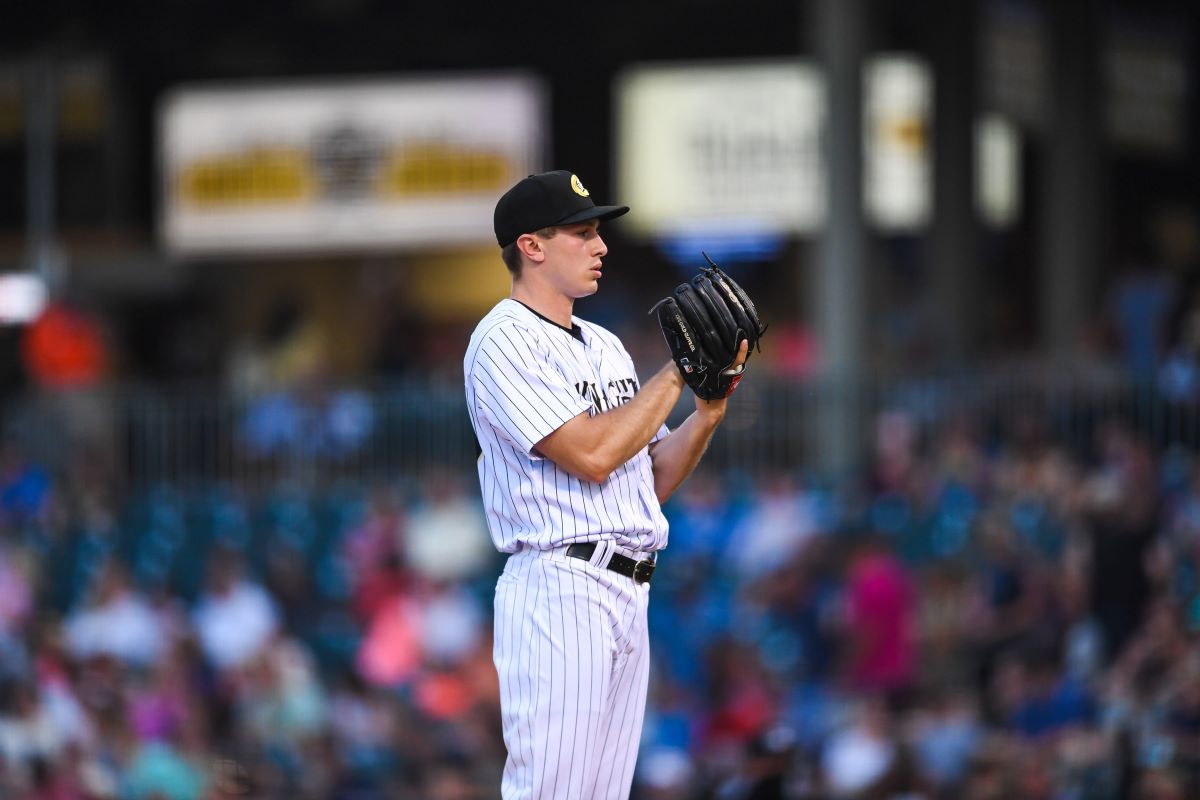
via Laura Wolff/Charlotte Knights
As the penultimate road trip of the 2021 Charlotte Knights season approaches its end, Jeff Cohen took time to answer questions regarding the Triple-A White Sox from the beat’s perspective.
Do you see Yermin Mercedes getting back to the major leagues?
Mercedes’ bat definitely plays in the big leagues. He is a gifted hitter, despite what probably is an unorthodox swing. The question is whether he is anything more than a DH at a time when teams are looking for positional flexibility. Mercedes continues to divide his time between catching and first base, but he’s yet to display a proficiency at either.
Who has the biggest upside: Jonathan Stiever or Jimmy Lambert?
At this point, Stiever may have the slightly higher ceiling. But it is close — it is rare to see them further than a couple of spots away from each other in any prospect ranking. Our latest FutureSox Top 30, released just two weeks ago, has Stiever at #12 and Lambert at #14.
Both showed progress in 2021, but Lambert is having the better year.
Lambert has pitched 59.2 innings in Charlotte, with a WHIP of 1.22, batting average against of .207, and 78 strikeouts. This is excellent for any Triple-A pitcher, but especially one who takes the mound in such a hitter-friendly home ballpark.
The White Sox dramatically cut Lambert’s workload in August so that’d he would be available for a spot start in September, and it seems to have worked. In his last two starts in August, as the team has stretched him back out, Lambert had one of his best fastballs of the year at 96. By his own admission, his slider command has been excellent all year, while his curve and change-up come and go.
He made a spot start this week for the White Sox in Oakland, went five innings and picked up his first major-league win.
Stiever, meanwhile, doesn’t stack up to Lambert statistically, but pitching coach Matt Zaleski told me in late August that his young hurler has made great strides this year and continues to demonstrate major-league talent. Like all young hurlers, repeatable mechanics and improved command remain his biggest challenges.
Through 17 starts and 74 innings, Stiever has a 1.46 WHIP and .265 batting average against, with 88 strikeouts and just 28 walks.
He recently had season-ending surgery but is expected to make a full recovery by spring.
Do Blake Rutherford and Micker Adolfo profile as every day MLB players?
If you ask their manager, both get a big thumbs up.
When I asked manager Wes Helms recently about Rutherford’s resurgence (.283/.308/.535 slash line in August), the manager said he sees fundamental improvements in his hitter’s plate approach, and firmly believes he has turned the corner. Yes, he said, Rutherford will be a MLB regular, with late-blooming power that will translate to 20-25 homers a year.
Rutherford followed up his August revival with a disastrous week in Norfolk, where he collected one hit in 22 at bats. But that’s just one week — in a season filled with peaks and valleys for the former 2016 first-round pick.
Helms is equally effusive about Adolfo. He maintains that Adolfo has the best outfield arm on the team, boasts tremendous power and will do things that “will amaze fans and opponents alike.” It is just a question of when.
Adolfo oozes talent, but there’s a lot of swing-and-miss in his game right now. He needs to keep putting in the time — in the batting cage, with the coaches and in the games. After this season, however, the White Sox lose the rights to the slugger unless he makes the major-league squad next year. So, yes, Adolfo could be a MLB regular in a year or two, but possibly not with the White Sox.
To be sure, this is an important final four weeks of the season for both players.
Will Wes Helms get a MLB shot?
My guess is yes. He has the requisite resume: a 12-year MLB career, success as a minor-league manager and a disciple of Bobby Cox. Like Cox, Helms is likeable, straight-forward and well-respected by players and peers.
I asked a former GM what are a MLB manager’s most important skills these days. He said the top two are, in order, an ability to communicate with players and media relations. Helms appears excellent at both. I am personally indebted to him for how generous he — and his coaches and players — are with their time, especially in this age of Covid when media relations can be challenging.
The Knights are more than 20 games under .500 this year, but Helms would be the first to tell you that that is meaningless. He has told me on multiple occasions that his goal is to help the White Sox win the World Series, not win a Triple-A World Series (there are no minor-league playoffs this year).
Helms’ top priority this year has been to prepare a reservoir of players for emergency use in Chicago, and there have been a ton of emergencies. And his guys have stepped in to fill the void with excellent results.
Helms — and hitting coach Chris Johnson, for that matter — deserve high praise for Gavin Sheets, who Helms managed in Birmingham in 2019 and again this year in Charlotte; Romy Gonzalez, who Helms managed at Instructs and again in Charlotte this season; and of course the incredible comeback of Jake Burger.
Helms also has a good track record this year of bringing out the talents of younger prospects like Blake Rutherford and Micker Adolfo, as well as Laz Rivera (before his season-ending injury) and Ti’Quan Forbes. And he continues to work tirelessly with Mercedes (among others) on his defensive skills, at first base in particular.
Pitching coach Matt Zaleski also performed yoemen’s work this year, most notably with the amazing turnaround of Reynaldo Lopez, as well as with the continued improvements of Stiever and Lambert. Much like Helms’ multi-year ties to Sheets and Gonzalez, Zaleski also was Stiever’s pitching coach in 2019.
How good is Triple-A umpiring?
Inconsistent, at best. But I guess the question is, compared to whom? Angel Hernandez? CB Buckner? Laz Diaz? It is probably hard to make the case that major-league umpiring is any more consistent.
Major-league baseball routinely evaluates the minor-league umpires, and by luck I recently had an opportunity to talk with an evaluator who was in Charlotte for a week. On a scale 1-10, with MLB umpires averaging a score of 10, he said minor-league crews are 8-8.5. He had high praise for their work in general and said they often go on to become some of the better MLB umpires.
On the night we happened to be talking, an umpire was clearly calling balls high and outside as strikes. I asked him if I was misreading the pitches, or if the umpire was widening his strike zone because a rain delay pushed the start of the game back an hour.
He didn’t mince words: “I don’t care if he wants to get home. Those were balls. I’ll talk to him about it.”
He had a harder time rating the work of the umpires in the lower minor leagues, in part because the umpires there often have to expand strike zones because the pitching is so bad.
Personally, I can recall about a half-dozen Knights’ games that dramatically turned on what appeared to be blatantly missed calls. But, again, I suspect that’s no different than the major leagues.
What does the team work on before a game?
In a word, everything. Shortly after a game concludes, the team receives the starting lineup for the next night, along with info on the starting pitcher, so players can begin their own individual prep.
Then, on the day of a game, players work on specific issues at an indoor batting cage with pitching machines that can replicate upper-90s fastballs and various breaking pitches. Later in the day, the players move onto the field to warm up with a strength and conditioning coach and then take their hacks at an outdoor batting cage.
As the guys rotate through the batting cage in groups of four or five to get in their reps, Helms stands off to the side hitting fungos to the infielders, often timing his ground balls between batting-cage pitches. A Rapsodo machine sits on the ground about 10 feet in front the hitters, spitting out exit-velo and launch-angle results on each swing that Chris Johnson can access in real time on an iPad.
The outdoor batting-cage work is actually when the fielders, especially outfielders, get in their best defensive practice as they work on reading balls off bats and getting jumps. After each batter takes his last round of cuts in the cage, he may run the bases so that he practices getting live reads of balls off bats as a baserunner.
The coaches often set aside time either earlier in the day or in lieu of outdoor batting-cage hitting just to work on defense. Helms will drill the infielders and catchers on a variety of plays and situations, while Johnson stands in foul ground with a machine that shoots fly balls to the outfielders.
In a recent game, Sheets lost a ball in the tricky rightfield corner of Truist Field for an error. The next day, Johnson lined up the machine so it sent one ball after another into the rightfield corner as Sheets, Rutherford and Mikie Mahtook took turns tracking them down.
Earlier in the day, coaches also work on the field with specific players on specific skills. So, when Burger started playing second base and missed two pop-ups behind first base in a game, Helms used the fly-ball machine to work one-on-one with Burger the next day.
The team also has three players at first base this season who’ve never played there before — Zach Remillard, Ti’Quan Forbes and Mercedes — so they get in plenty of extra time to work on their footwork around the bag and digging throws out of the dirt.
Finally, at 5:15 PM, the players assemble to go over the pitcher they’ll be facing that night.
Johnson also helps players prepare individually, relying heavily on TrackMan data that is recorded in Charlotte and crunched in Chicago. How much data he shares with the team depends on each player’s appetite for and ability to use the information. Veterans get more leeway to prepare on their own.
Starting pitchers, meanwhile, throw on the third day after a start. Relievers throw as needed. It is a personal preference whether a pitcher throws at or near 100% in a side session. As with the position players, invidual pitchers put in a lot of one-on-one work with Zaleski to clean up delivery mechanics and work on specific pitches.
What are the players like?
Each one has proven to be nicer than the next. They are very generous with their time, approachable and friendly during interviews.
They also strike me as very dedicated to their craft; after all, they are just one step from the big leagues and most of them have been in the minors for four, five or six years. They put in a lot of time to improve various aspects of their game.
Are you surprised that Mike Wright got a call-up?
Absolutely. But I thought he deserved a shot and am thrilled that he got the chance (he was called up Aug. 16).
While virtually every other Knights’ starter had his stumbles this year, Wright was a model of consistency, pitching at least five innings in all but one start. Prior to his call-up, he was among the leaders in the 20-team Triple-A East in innings, wins and WHIP.
I thought this showing would earn him a spring invite next season somewhere. The White Sox have had a 40-man roster crunch all season and I didn’t see them clearing a spot for Wright. But they did, releasing former number-one pick Zack Burdi. That’s high praise.
It has been a tough climb back to the majors for Wright. From 2015-2019, Wright had 110 major-league appearances, including 23 starts. Opponents hit .294 and he pitched to a 1.56 WHIP. He found his way to the KBO in 2020, which helped him maintain arm strength when most other US pitchers had to be coddled early this year.
As I’ve said many times, he’s an easy guy to pull for. He takes the ball every fifth day, attacks hitters and is passionate about the game.
Photo credit: Laura Wolff/Charlotte Knights
Want to know right away when we publish a new article? Type your email address in the box on the right-side bar (or at the bottom on a mobile device) and click “create subscription.” Our list is completely spam free, and you can opt out at any time. Also, consider supporting FutureSox on Patreon! You can get early access to special articles and Patreon-only posts, in addition to more benefits.
Shop our exclusive merchandise! Show your support with FutureSox apparel.