2026 MLB Draft Profile: Roch Cholowsky
NAME: Roch Cholowsky
SCHOOL: UCLA
POSITION: Shortstop
HEIGHT/WEIGHT: 6-2, 202
B/T: R/R
D.O.B: 4/7/2005
PREVIOUSLY DRAFTED: N/A
Scouting Report
The longer a player sits atop a draft board, the easier it becomes to find reasons to talk yourself out of him.
Roch Cholowsky entered the 2026 season as the consensus favorite to be selected first overall. MLB Pipeline even turned the discussion into a recurring “Roch Watch” segment as each strong weekend seemed to settle the question and every quiet stretch reopened it.
Cholowsky did not repeat the historic sophomore season that moved him to the top of the class. Georgia Tech catcher Vahn Lackey closed the gap with an outstanding junior year and Grady Emerson developed into a legitimate high school alternative.
None of that turned Cholowsky’s season into a disappointment.
He hit .320/.452/.636 with 21 home runs and finished as a Golden Spikes Award finalist. His UCLA career ended with a .329/.447/.624 slash line, 52 homers and 41 doubles. He also remained one of college baseball’s best defensive shortstops, finishing his junior season with 15.3 defensive runs saved.
As MLB Pipeline’s Jim Callis described it, Cholowsky “held serve.”
The phrase fits. His junior season did not create the separation some expected, but it gave evaluators little reason to move him far from the top. Baseball America still ranks him as the best prospect in the class, while MLB Pipeline gives him a 65 overall grade.
If the White Sox select Cholowsky first overall, he would become just the third college shortstop taken with the first pick. Bill Almon went first in 1974 and Dansby Swanson followed in 2015.
The position helps explain why his profile is so uncommon. Most shortstops talented enough to become top draft prospects sign out of high school. Cholowsky instead spent three years at UCLA and developed into one of the most complete players available.
Baseball America’s Carlos Collazo has described the profile as “generational” because of how rarely this combination reaches the draft through college. J.J. Cooper offered an important qualification during the same discussion. The label reflects scarcity more than guaranteed major league stardom.
Legally named Daniel but known as Roch, the Chandler, Arizona, native attended Hamilton High School, following the path of his father, Dan. The elder Cholowsky was the 39th overall pick in the 1991 draft by the St. Louis Cardinals; after an eight-season professional career, he transitioned into scouting and currently serves as an area scout for the Cincinnati Reds.
Roch was also a multisport athlete. He played basketball and became a three-star quarterback prospect at Hamilton. He opened his senior football season 3-1 before his ankle caught in tall grass during a tackle and twisted his knee, causing a torn meniscus that ended his year after four games. Cholowsky later said he never regretted playing football. Hamilton baseball coach Mike Woods believed the sport made him tougher and more aware of how his actions affected teammates.
At shortstop, Cholowsky takes charge of the infield and plays with an advanced internal clock that keeps him under control as plays develop.
In an interview with Just Baseball before the season, Cholowsky said football taught him that little works unless every player understands his assignment. That experience helped shape the way he leads on the baseball field.
Cholowsky was already a prominent draft prospect in 2023. Baseball America ranked him No. 42 in the class after he hit .466 with 11 home runs as a senior. He also helped Hamilton win its second consecutive state championship.
The defense provided the foundation of his profile. Evaluators were less certain about how much offensive impact he would produce as his frame matured.
The White Sox were among the clubs that made a serious attempt to sign him. Cholowsky turned down at least $3 million before honoring his UCLA commitment.
Chicago has maintained that familiarity throughout the current draft cycle. Amateur scouting director Mike Shirley confirmed the organization’s history with Cholowsky while discussing the first pick.
“We spent a lot of time on him in high school,” Shirley said. “We know the kid, know the family.”
Cholowsky chose UCLA because he believed there was more development ahead and has talked about how watching Paul Skenes pitch at the College World Series helped reinforce that decision.
His freshman season required patience. Cholowsky recovered from a slow start to hit .308 with eight home runs over 52 games. He earned Freshman All-American recognition and established himself as UCLA’s starting shortstop.
The following season moved him to the top of the 2026 class.
Cholowsky hit .353/.480/.710 with 23 home runs and 74 RBIs over 66 games. He helped UCLA return to the College World Series and won the Brooks Wallace Award as the nation’s top shortstop.
The Big Ten named him its Player of the Year and Defensive Player of the Year. Baseball America selected him as its College Player of the Year, making him one of the few sophomores to receive the award.
His strikeout rate finished at 9.3%. Baseball America also credited him with a 91.5 mph average exit velocity and a 90% in-zone contact rate. Against pitches thrown at least 92 mph, Cholowsky hit .341/.449/.537.
The added power followed a physical transformation.
Cholowsky arrived at UCLA with a leaner frame and added roughly 20 pounds of muscle. He credited a greater commitment to nutrition and the weight room. The added strength did not take away from the movements that made him an advanced defender in high school.
His setup changed with his body.
Cholowsky widened his base and began starting closer to his eventual hitting position. His leg kick became less vertical and moved more toward the baseball. Those changes gave him more time to repeat the swing while allowing his lower half to create greater force.
The result was consecutive 20-homer seasons. His exit velocities reached approximately 114 mph, while his bat speed has been measured around 75 mph on Hawk-Eye.
The production stands out even among his most common major league comparisons. Cholowsky hit 44 home runs over his final two seasons, more than Alex Bregman and Dansby Swanson hit during their entire college careers combined. His 21 homers in 2026 matched Bregman’s career total and exceeded the full college totals of Swanson, Troy Tulowitzki and Brandon Crawford.
The Dylan Crews comparison works only as broad shorthand for a highly productive college hitter with a near-complete profile. Cholowsky’s batted-ball shape is different, with a higher fly-ball rate and fewer ground balls. That gives his power a cleaner path to translating in games, while a small Friday-only sample should not outweigh the larger body of work.
The offensive evaluation begins with how consistently Cholowsky puts the bat on the baseball.
Over Slot credited him with a 16.8% whiff rate in 2026. His in-zone whiff rate was 10.4% and his chase rate finished at 20.9%. Just Baseball charted him with an 82% overall contact rate and an 89% mark inside the strike zone.
Cholowsky recognizes spin and can adjust to secondary pitches. His strength also gives him broad plate coverage. He can drive pitches on the outer half to right field instead of merely serving them into play.
There is little evidence of a broad velocity problem. The concern is more specific.
Fastballs at the top of the strike zone or on the inner third can disrupt his path. His hands occasionally drift away from his body and leave limited room for the barrel. A larger leg lift can also make him late when pitchers elevate. That can produce infield pop-ups or weak contact on hittable fastballs.
The concern appeared during an otherwise encouraging weekend against Tennessee, Texas A&M and Mississippi State at Globe Life Field.
Cholowsky went 3-for-11 during the tournament but whiffed only twice on 20 swings. His best moment came against Mississippi State when he hit a game-tying home run that left the bat at 105.5 mph.
The home run showed how much damage he can produce when the barrel arrives on time. Other plate appearances showed where professional pitchers may attack him.
Cholowsky uses a noticeable barrel tip and can become busy with his hands during the load. Over Slot has noted that the barrel occasionally gets barred when he is fooled, while other evaluators have questioned whether his high finish and late top-hand turnover will translate cleanly to professional pitching. Simplifying the operation could shorten the path and give him more room to adjust against velocity.
Cholowsky’s bat-to-ball ability is not in question. The bigger test is whether he can turn that contact into consistent damage against professional pitching.
That distinction explains the disagreement over his hit tool.
MLB Pipeline gives Cholowsky a 60 grade for both hitting and power. Over Slot also projects a plus hit tool. Keith Law is more conservative and places the projection closer to average or slightly above average.
FanGraphs has raised similar concerns. Its evaluation points to the length in Cholowsky’s levers and projects the hit tool below the rest of his offensive profile.
The quality-of-contact data gives those evaluators something to question.
Cholowsky’s average exit velocity reached 92.9 mph in 2026. His 90th-percentile mark was 108 mph and his maximum reached 113.8 mph. The top-end impact is clearly present.
He did not access it as consistently as he did during his sophomore season.
His hard-hit rate fell from 60% in 2025 to 49% this spring. He also went from 19 doubles as a sophomore to 10 as a junior. The home-run total barely changed, but the frequency of hard contact declined.
That should not erase the larger record.
Cholowsky still hit 21 home runs and maintained strong contact rates. Baseball America noted that his 11.7% strikeout rate over the past three seasons was the lowest among the 30 college hitters who produced at least 45 homers during that span.
That combination defines much of his appeal. He does not need to accept a traditional power hitter’s strikeout rate to reach his home-run production.
Even his quieter stretches rarely became empty ones. Cholowsky continued drawing walks when the power disappeared. His on-base percentage remained above .450 during a season viewed as a step backward.
There were also signs that the timing issues could be adjusted.
Late in the season, Cholowsky reduced the size of his leg kick and worked from a more upright position. The quieter lower half appeared to help him enter the hitting zone sooner. He responded by hitting three home runs over the final two games of a series against Oregon.
The change did not eliminate every concern. Pitchers could still challenge him above the zone and on the inner third. It showed that Cholowsky could identify a problem and adjust without losing the power that makes the profile attractive.
He does not need a new swing. He may need a simpler move into the one he already has.
His limited wood-bat record is worth noting. Cholowsky did not produce much during a short stay in the Cape Cod League after his freshman season or with Team USA in 2025. Neither sample is large enough to carry the evaluation, but the results add some uncertainty to how quickly his offense will translate.
The complete picture remains strong.
Cholowsky finished his junior year with a 146 wRC+ and as many walks as strikeouts. His OPS declined from 1.190 to 1.088, but he remained one of the most productive hitters in college baseball.
The power is real and the bat-to-ball ability provides a strong foundation. His professional development will center on turning that contact into more consistent damage.
The defense requires much less projection.
Cholowsky won a collegiate Gold Glove after the 2025 season. MLB Pipeline gives him 60 grades for both his fielding and arm. Baseball America also projects Gold Glove upside.
His first step allows him to create more range than his straight-line speed would suggest. Cholowsky reads the ball early and takes efficient routes. His ability to track shallow fly balls into the outfield has become one of the most recognizable parts of his defensive game.
The actions are smooth without becoming casual. Cholowsky remains balanced when charging slow rollers and can finish throws from different arm angles. His accuracy holds when he is moving away from first base and there is little question about the arm strength.
Difficult plays rarely look rushed because he creates time through anticipation. That internal clock may be the strongest part of his defense.
Pure speed is the lightest tool, although he has been timed at a 4.15 second home plate to first base and still moves well laterally at short. MLB Pipeline grades him as a 45 runner, while Over Slot places a 50 on it. He is unlikely to produce much value through stolen bases.
Some evaluators wonder whether his thicker frame could eventually reduce the range. Cholowsky is already physically mature and should not need to add much more weight.
Even the more cautious projections still see an above-average major league shortstop during his prime. The disagreement is whether he becomes an elite defender or settles one level below it.
He should receive every opportunity to remain at the position.
Second or third base would provide alternatives if his range declines later in his career. Some evaluators also believe his ability to track balls into the outfield could make center field an option. Moving him immediately would reduce one of the strongest parts of the profile.
The makeup also receives strong reviews. UCLA coach John Savage has called Cholowsky a “head coach’s dream,” pointing to the leadership and work ethic he brings to practices, meetings and the weight room. That reputation matches the way Cholowsky directs the infield and remained committed through a difficult first season before developing into one of the best players in college baseball.
Several evaluators have called Cholowsky one of the best leaders they have interviewed while covering the draft. Coaches and teammates have praised his preparation. He takes responsibility for organizing the defense and remains engaged when his bat is quiet. He shows that he lives and breathes baseball.
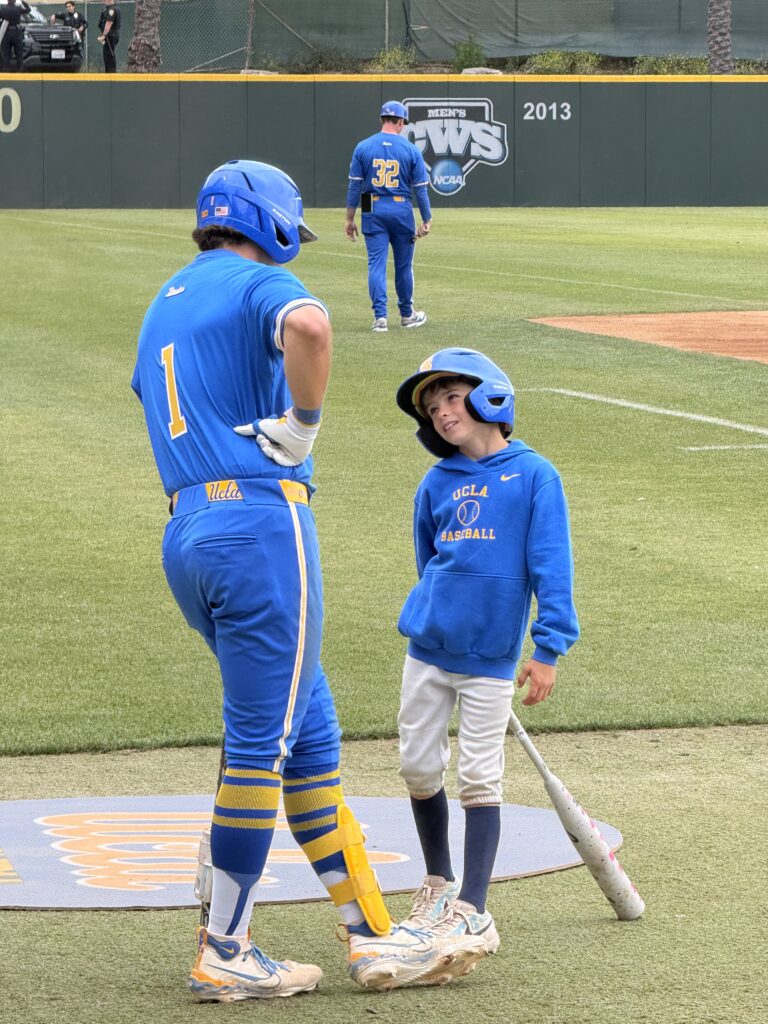
He has also displayed that leadership in game situations. Cholowsky uses brief moments between pitches to help teammates refine fundamentals and improve execution.
He plays with visible effort and tends to redirect attention toward UCLA during interviews. His quarterback background shows through in more than the way he moves at shortstop.
The most likely outcome is an everyday shortstop with above-average power and significant defensive value.
Cholowsky produced 4.6 WAR as a junior at UCLA. Even if the hit tool settles around average, his defense and 20-homer power still give him a path to becoming a three-to-four-win major leaguer.
A more consistent answer against inner-half velocity could allow Cholowsky to hit 25 or more home runs while remaining an above-average defender.
That would give him an All-Star ceiling at one of the most valuable positions on the field.
Why Would The White Sox Draft Roch Cholowsky?
The White Sox could select Roch Cholowsky because he offers the strongest combination of certainty and upside among the candidates at the top of the class.
Chicago has evaluated him since high school. Shirley and general manager Chris Getz were both part of the organization when the club tried to sign him in 2023.
That familiarity does not make the selection automatic. It gives the White Sox more information on the player and his development than they would normally possess with a first overall candidate.
Cholowsky also fits the type of player Chicago has targeted under Shirley. The organization has consistently prioritized athletes who can remain in the middle of the field. Cholowsky provides that defensive value without requiring the White Sox to project where he will play.
The presence of Colson Montgomery should not influence the decision.
Montgomery has played well at third base and could eventually settle there. Even if the White Sox still view him as a shortstop, the organization can solve the alignment when the two players are sharing the dirt together.
Cholowsky should remain at shortstop for as long as the defense supports it. If Montgomery settles at third and both players develop, Chicago could eventually have a dynamic pairing on the left side of the infield.
Cholowsky would also add another right-handed hitter with power potential. That should not drive the pick, but it would provide a different look within a young position-player group that includes several prominent left-handed bats.
The offensive questions should give the White Sox a development plan rather than a reason to avoid him.
Chicago has invested heavily in its hitting infrastructure under director of hitting Ryan Fuller. Cholowsky would require refinement instead of reconstruction.
The bat speed is already present. He makes contact at a high rate and understands the strike zone. His strength produces major league exit velocities.
The next step would involve simplifying the operation and creating more room against inside velocity. Fuller and major league hitting coach Derek Shomon have emphasized helping hitters access pull-side damage (48% Hard-hit pull/14 degree Hard-hit launch angle). That approach could help Cholowsky turn more of his contact into extra-base production.
Chicago would also need to sharpen his damage-zone selection so fewer hittable strikes result in harmless contact.
Cholowsky has already shown that he can adjust. He added strength at UCLA and changed his setup without sacrificing contact. Those changes helped turn a contact-oriented high school hitter into a player with consecutive 20-homer seasons.
The former Bruin offers the clearest path to value because his projection does not depend on one specific outcome. Even if several tools finish one grade below their highest projections, his position and defensive ability still provide protection.
At his offensive ceiling, Cholowsky profiles as a middle-of-the-order shortstop. Even with a hit tool closer to average, his defense and power should support an everyday role.
Bonus strategy should remain secondary. Creating significant savings could also be difficult because Cholowsky, Emerson and Jacob Lombard are all represented by The Team (Wasserman), which may limit Chicago’s leverage in pushing any of them well below slot.
The first pick carries a slot value of $11,350,600, while Chicago controls a total pool of $17,592,100 with a 5% overage.
A record-setting bonus around $9.5 million or above would still save around $1.85 million against the slot.
That money could help Chicago remain aggressive later in the draft. The White Sox should still select Cholowsky only if they believe he is the best player.
His Arizona background would make the first professional spring familiar. Chandler is less than an hour from Camelback Ranch, and Cholowsky would be a natural candidate for early exposure to major league camp.
The White Sox would need to give Cholowsky enough minor league time to adjust to wood bats and professional velocity. His college experience could allow him to move quickly, but the organization should not treat him as an immediate major league solution.
Mock Draft Outcomes
Cholowsky remains the most common projection to the White Sox and the top player on most public boards.
Baseball America ranks him first and projected him to Chicago in its fourth mock draft. MLB Pipeline also sent him to the White Sox in its June mock.
Kiley McDaniel’s earlier intel-based mock described the decision as close to a coin flip and reported buzz that some key White Sox evaluators preferred Emerson. In a later exercise based on who each team should take, he still selected Cholowsky because of his proximity to the majors, lower risk and more established profile.
The most notable departures have come from Keith Law’s mocks. Law first projected Emerson to Chicago and later moved Lackey into the top spot after hearing increased interest in the Georgia Tech catcher. Law still ranked Cholowsky as the best player in the class on his personal board.
Over Slot also ranks Lackey ahead of Cholowsky. That reflects its player evaluation rather than a prediction that Chicago will make the same choice. Here at FutureSox, James Fox has stated that he won’t be deviating from the UCLA product at #1 and it’s the projection in Mock Draft 2.0 as well.
Those differences show that the White Sox have a legitimate decision. They have not changed Cholowsky’s narrow expected range.
Tampa Bay and San Francisco have both been connected to him if he gets past Chicago. Cholowsky confirmed that he met with both clubs at the MLB Draft Combine. It would be a surprise if he remained available beyond the fourth pick. Cholowsky also recently visited Chicago to meet with White Sox’s brass.
Most evaluators entered the year with Cholowsky at the top of the class. After a full season of “Roch Watch,” most still have him there.
Three years after trying to sign him out of high school, the White Sox may finally have their chance to take the player who still looks like the best choice at No. 1.