White Sox select SS Roch Cholowsky No. 1 overall in 2026 MLB Draft

FutureSox
The Chicago White Sox selected UCLA shortstop Roch Cholowsky with the No. 1 overall pick in the 2026 MLB Draft.
Cholowsky becomes the first player selected first overall by the organization since Harold Baines in 1977. He is also just the third college shortstop taken with the top pick, joining Bill Almon in 1974 and Dansby Swanson in 2015.
That history reflects how rarely a player with Cholowsky’s profile reaches college. Most premium prep shortstops sign out of high school. Cholowsky instead turned down significant money in 2023 and developed into one of the most complete college shortstop prospects in years. Baseball America examined the rarity of that path before the draft.
The White Sox had Cholowsky near the center of their evaluation from the moment they won the draft lottery. During a CHSN broadcast the night before the draft, Director of Amateur Scouting Mike Shirley said Cholowsky was “front and center” when the organization first began identifying the best player available.
“At that point, Roch had kind of solidified himself as possibly the best player in the draft,” Shirley said.
Chicago still worked through every segment of the class, comparing the top college and high school hitters with the leading pitchers. Cholowsky remained a central option throughout the process.
The familiarity went back even further. The White Sox made a serious attempt to sign him out of Hamilton High School before he followed through on his commitment to UCLA.
“We spent a lot of time on him in high school,” Shirley said after the lottery. “We know the kid, know the family.”
Three years later, Chicago finally landed him.
Cholowsky remained near the top of every major board despite Grady Emerson and Vahn Lackey closing the gap during the spring. Baseball America, Perfect Game and Just Baseball ranked him first. MLB Pipeline placed him second behind Emerson and gave him a 65 overall grade.
By draft morning, the industry had largely converged on Cholowsky. Baseball America, ESPN, MLB Pipeline, Over-Slot and The Sporting Tribune all projected him to Chicago. Keith Law remained the most prominent final holdout with Grady Emerson at No. 1.
The final decision remained close because the White Sox did not view Cholowsky and Emerson through the simple floor-versus-ceiling distinction that shaped much of the public discussion.
Shirley said some evaluators inside the room would reverse the common framing that Cholowsky offered the higher floor while Emerson carried the greater ceiling. Chicago saw more present security in Emerson’s skill set than the typical high school profile, while also identifying areas where Cholowsky could continue developing.
“There are people in our room that would have that flipped,” Shirley said during an interview with 104.3 The Score.
Cholowsky still provided premium defense, a long college track record and a quicker path through the minor leagues. The selection reflected more than a preference for certainty. Chicago believed his existing foundation left room for additional offensive growth.
Shirley confirmed that Cholowsky, Emerson and Vahn Lackey formed the final group under consideration after other players, including Jacob Lombard, had surfaced earlier in the process. He described the separation among the finalists as extremely small.
Selecting Cholowsky ultimately aligned Chicago with the broad draft-morning consensus after a decision that remained competitive until the final hours.
The 6-foot-2, 202-pound shortstop hit .320/.452/.636 with 21 home runs during his junior season. Cholowsky finished his UCLA career with a .329/.447/.624 slash line and 52 homers over 178 games.
Cholowsky walked as often as he struck out this spring. His career strikeout rate finished at 11.7% despite hitting 44 home runs over his final two seasons.
Cholowsky posted an 82% contact rate in 2026 with an 89% mark inside the strike zone. His average exit velocity reached 93 mph and his maximum finished at 113.8 mph. Baseball America’s final data review also credited him with a 19.1% chase rate and a .333/.455/.556 line against pitches at least 94 mph. Just Baseball’s final board gave him 60 grades for both hitting and game power.
Shirley offered a similar assessment of the damage Cholowsky can create.
“He can get dangerous in a hurry,” Shirley said. “You go to the wrong spot in the zone, he’s going to get you.”
Those results suggest velocity alone is not a weakness. The more specific question is how consistently Cholowsky can reach his best contact against fastballs at the top of the zone or near his hands.
His load can become busy. A bat wrap occasionally leaves him late against fastballs and limits the space available for the barrel near his hands. FanGraphs offered the more conservative view of his offense, projecting a power-over-hit profile because of those swing characteristics.
That concern should give the White Sox a development plan rather than require a complete reconstruction. Cholowsky already showed that he can make changes without losing his strengths.
He arrived at UCLA with a leaner frame and added roughly 20 pounds. He also changed his setup as his body developed. Those adjustments helped turn a contact-oriented high school hitter into a player with consecutive 20-homer seasons.
Cholowsky’s limited wood-bat record remains one of the few questions. He hit .218/.338/.327 in a short Cape Cod League stint and later struggled with Team USA, though both samples were small compared with his three seasons of production at UCLA.
The defense carries much less uncertainty.
Cholowsky moved from third base to shortstop as a sophomore and immediately won the Brooks Wallace Award and a collegiate Gold Glove. Baseball America credited him with 20 defensive runs saved that season. He was the only shortstop to reach that mark since the data began being tracked in 2023. Baseball America’s full scouting report described him as one of the better college shortstop prospects of the past decade.
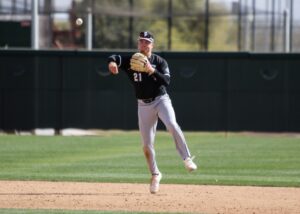
Cholowsky reads the ball early and rarely appears rushed. His internal clock helps him finish difficult plays without forcing the action. He can throw from different angles and remains accurate while moving away from first base.
His first step also creates more range than his straight-line speed would suggest. MLB Pipeline graded his fielding and arm at 60 while Baseball America projected Gold Glove upside.
The White Sox should give Cholowsky every opportunity to remain at shortstop.
Chicago already has Billy Carlson, Caleb Bonemer and Colson Montgomery in the organization. Their presence should not affect a best-player-available decision.
Each player can continue developing at his current position. The White Sox can address any overlap when multiple players reach the same level. Until then, shortstops provide defensive flexibility and trade value throughout a farm system.
Cholowsky and Colson Montgomery could eventually give Chicago one of the league’s more dynamic left sides. Cholowsky projects as a premium defender with 20-plus home run power at shortstop, while Montgomery could preserve his body at third and bring more power upside. Montgomery would also become one of the best defensive third basemen in baseball and not much would get past that duo.
With Miguel Vargas and Munetaka Murakami also part of the mix, Chicago could eventually feature 20-plus homer potential across nearly the entire infield. Even second base could approach that mark through the combined production of Sam Antonacci and Chase Meidroth.
The selection continues a clear first-round pattern under Shirley. In seven drafts as scouting director, the White Sox have now selected four shortstops and three left-handed pitchers with their first pick.
Shirley’s evaluation of Cholowsky extended beyond the physical tools.
He also praised the way Cholowsky handled the responsibility of captaining UCLA while carrying first-pick expectations throughout the spring.
“This guy wants to win the ballgame,” Shirley said. “He shows up every day to be a leader.”
Shirley also called him a “super intelligent player” and described him as a quarterback on defense, pointing to the aptitude behind the tools and the way he organizes the entire unit.
UCLA coach John Savage offered a similar assessment. He called Cholowsky a “head coach’s dream” because of the preparation and leadership he brought to the program.
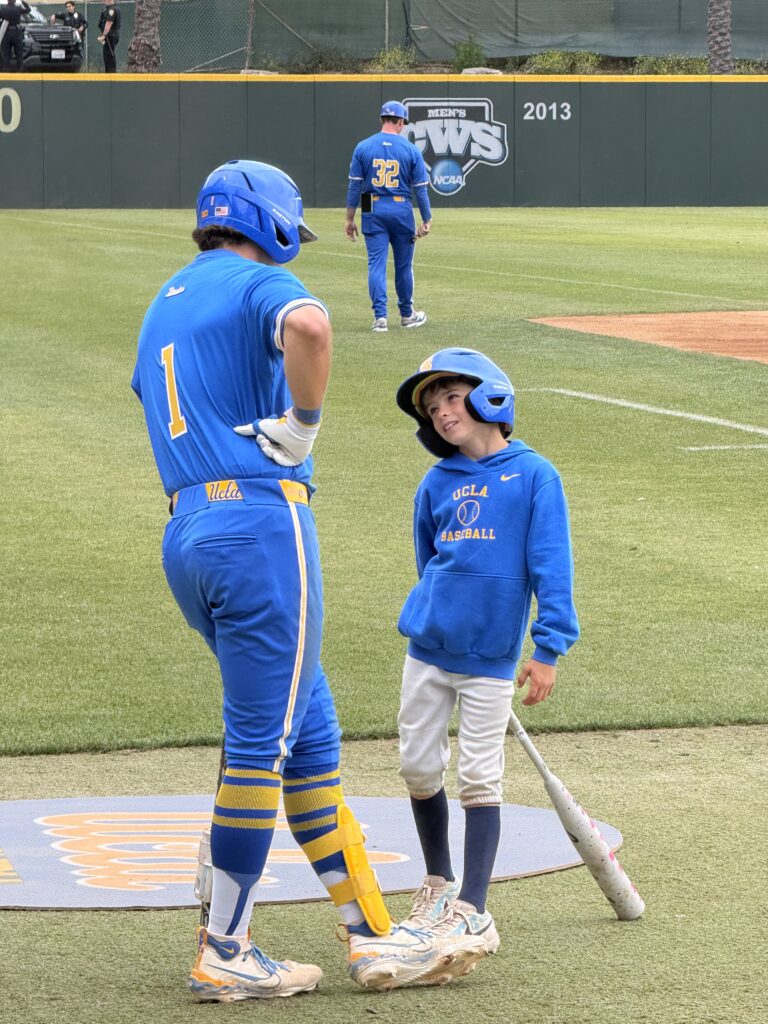
That reputation extended well beyond the field. As detailed in Ben Bolch’s profile of Cholowsky, he organized a team visit with teenage cancer patient Johnny Brande before UCLA’s 2025 postseason run. Cholowsky remained in contact afterward and later honored Brande by writing his initials on his cleats.
The Athletic’s February profile detailed how Cholowsky organized player-led goal meetings, studied UCLA’s pitching plans and helped establish the standards for a program that returned to national contention. Savage said he was often a step ahead, whether preparing for an opponent or setting the tone for teammates.
Shirley said Cholowsky “is a leader already” and believes he will gravitate naturally toward a professional clubhouse.
That quarterback description also reflected Cholowsky’s multisport background. Cholowsky was a three-star prospect at Hamilton High School before a torn meniscus ended his senior season after four games. He later said he never regretted playing football, while his coaches believed the sport sharpened his toughness and awareness of how every assignment affects the group.
Baseball also runs through his family. His father, Dan, was selected 39th overall by the St. Louis Cardinals in 1991. He played eight professional seasons before becoming an area scout for the Cincinnati Reds.
Cholowsky immediately becomes one of the top prospects in the White Sox system. Baseball America gave him a 65 grade and identified him as an immediate Top 100 candidate. Carlos Collazo argued for a top-five placement, though others at the publication may start him in the 6-10 range.
ESPN’s Kiley McDaniel projected Cholowsky to rank No. 19 once he signs, ahead of Grady Emerson at No. 24 and Vahn Lackey at No. 25. All three landed in McDaniel’s 55 FV tier, reinforcing how closely the top of the class was viewed despite the differences in exact placement.
The most likely outcome is an everyday shortstop with above-average power and significant defensive value. Even if the hit tool finishes closer to average, his glove and home-run production provide several paths to becoming a productive major leaguer.
Selecting Cholowsky also reflects confidence in the White Sox hitting-development group led by Ryan Fuller. Chicago does not need to rebuild his swing. The contact quality and exit velocities are already there. The focus could be creating more room against inside velocity and helping him use his bat speed with greater pull-side intent.
That could unlock another level of game power without forcing him to abandon the approach that made him productive at UCLA. Even if the hit tool settles below its highest projection, the White Sox could lean further into the power and defensive value already present in the profile.
That is the type of refinement the organization has prioritized under Fuller. The progress made by Caleb Bonemer gives Chicago reason to trust the hitting group with a player whose foundation is already this advanced.
Shirley also pointed to the development of Grant Taylor, Colson Montgomery, Noah Schultz, Sam Antonacci and Sean Burke as evidence of a stronger handoff between amateur scouting and player development. Several carried questions when they were drafted, but each has since reached or approached the major league level.
The final decision was not made in isolation. Shirley described the process as “delicate, but fun” and said amateur scouting, player development and the front office all contributed while the organization evaluated the players alongside its bonus-pool strategy.
“There are so many great people in that room,” Shirley said. “The collaboration is elite, in my opinion.”
The draft also fit the broader direction established by Chris Getz. Shirley said Getz has emphasized sustainability and the long-term health of the organization rather than allowing its current success to shorten the development timeline.
The goal is to keep adding depth and avoid the peaks and valleys that can follow a short competitive window. Shirley said the White Sox wanted to secure the right player at No. 1 and build a deep class because he does not expect the organization to continue selecting near the top of the draft.
The financial picture changed when Chicago acquired the No. 34 pick from Pittsburgh. That selection added $2,897,400 to the White Sox bonus pool, raising it to $20,489,500, the highest total allotment since the bonus-pool system began in 2012. With the permitted 5% overage, Chicago can spend up to $21,513,975.
That flexibility gives the White Sox several ways to attack the rest of the draft. Savings at No. 1 could be paired with the No. 34 slot to pursue another premium talent, while still leaving room to get aggressive with selections at Nos. 41, 77 and 105 or later on Day 2.
Cholowsky’s college experience could help him move quickly, but the organization should not treat him as an immediate major league solution. He still needs time to adjust to professional velocity and consistent wood-bat competition.
For a deeper look at his swing, defensive value and White Sox fit, read the full FutureSox draft profile on Roch Cholowsky.
After pursuing him out of high school three years ago, the White Sox finally have Roch Cholowsky in the organization.