White Sox calling up Rikuu Nishida from Triple-A Charlotte
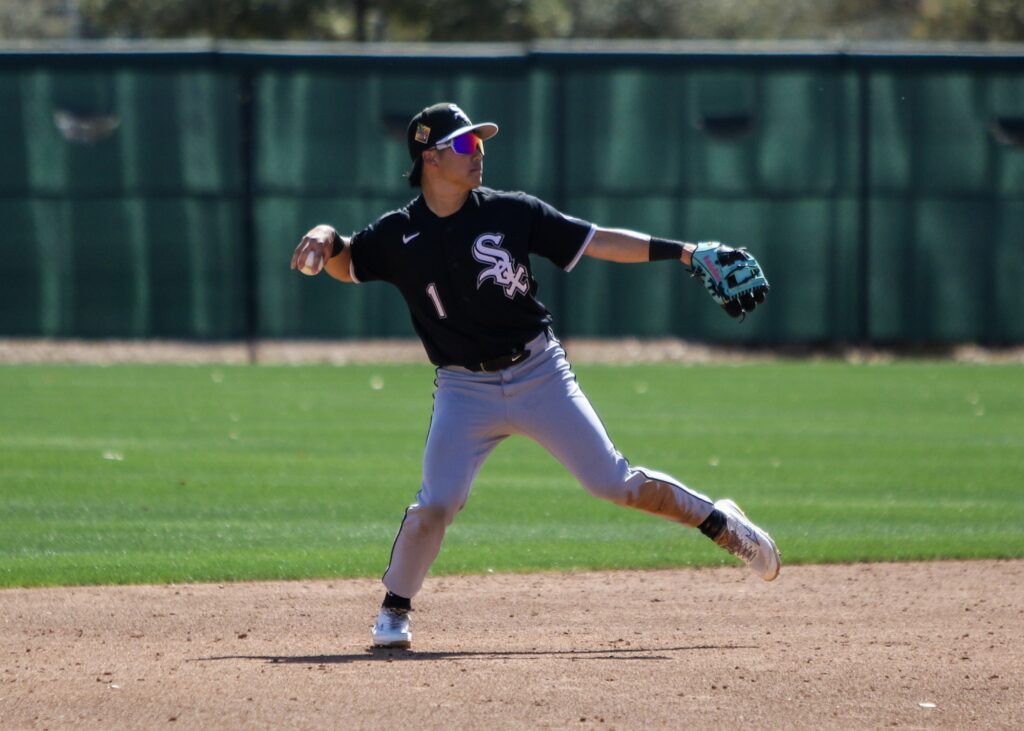
Rikuu Nishida is headed to Chicago and he will wear #51.
The White Sox are calling up the 25-year-old infielder/outfielder from Triple-A Charlotte, a move first reported by Ian Eskridge of FutureSox and later confirmed by Chuck Garfien. Outfielder Jarred Kelenic has been designated for assignment to create the 40-man spot.
The move gives Nishida, one of the most unique players in the system, his first major league opportunity.
The left-handed hitter is not a traditional top prospect. He is 5-foot-6, 150 pounds, has limited power and does not have one fixed defensive home. That profile can be easy to overlook. His production has made it harder to do that.
An 11th-round pick out of Oregon in 2023, Nishida has hit .319/.445/.381 with a 127 wRC+ across 43 games between Double-A Birmingham and Charlotte this season.
Since joining the Knights in April, he has hit .342/.449/.392 with a 125 wRC+, 32 runs, 20 walks, 26 strikeouts and nine stolen bases in 32 games.
Nishida is not going to change a game with raw power, though he did homer in his Triple-A debut for just his second home run as a member of the organization. His value comes from everything around that.
A different kind of offensive profile
Nishida’s profile comes with clear physical limitations, especially in how much impact he produces on contact. The ball does not jump off his bat, so major league pitchers will test whether they can challenge him in the zone without paying for mistakes.
Still, his strike-zone control and bat-to-ball skill have carried the profile at every stop. He has walked and struck out at identical 15.2 percent clips this season while posting a .445 on-base percentage in 2026.
White Sox director of hitting Ryan Fuller recently told MLB.com that Nishida has “embraced who he is as a player,” pointing to his ability to find ways to first base.
That skill set has stood out inside the organization. In a Sun-Times story this week, White Sox director of player development Paul Janish called Nishida “one of the best baseball players” in the system and said he is “contagious in the best way.”
That line fits the player. Nishida’s value comes from how often he keeps himself involved in the game, whether that is extending an at-bat, putting pressure on the bases or forcing a defense to make a clean play. For a White Sox team that has leaned into athleticism under Will Venable, that gives him a natural path to usefulness.
The path to the White Sox
Nishida’s path is as unusual as the player.
He was born in Osaka, Japan, came to the United States for college baseball and eventually transferred to Oregon. In 2023, he hit .312 with an .837 OPS and set the Ducks’ single-season stolen base record with 25 before the White Sox selected him in the 11th round and signed him for $170,000.
Nishida also stood out at Oregon for using a wood bat in a college game built almost entirely around metal. It became part of what made him such an unusual draft case. He was already using professional equipment, already relying on bat control over raw power and still produced enough to become the Nashville Regional MVP during Oregon’s run to the Super Regionals.

If Nishida makes his major league debut, he is believed to become the first Japanese-born player drafted out of a U.S. college to reach MLB. That path should not be treated casually. Most Japanese players who make it to the majors arrive after playing professionally in Japan, while Nishida’s route has taken him from Osaka to Mt. Hood Community College, Oregon, the 2023 MLB Draft and now the White Sox roster.
He moved quickly after signing. Nishida reached three affiliates in 2024, finishing the season with Double-A Birmingham. He spent 2025 back in Birmingham, posted a .403 on-base percentage and stole 40 bases. This year, he made the jump to Charlotte and quickly became one of the Knights’ most productive hitters.
His time in Birmingham gave the White Sox a cleaner look at how his game fits on winning teams. Nishida was part of back-to-back Southern League championship clubs, and for a major league roster trying to carry more of its player-development wins to Chicago, that background adds to the fit.
Nishida has also continued to evolve defensively. He prefers second base, but he has played every outfield spot in the minors. He has taken regular work at both infield and outfield spots with Charlotte, which gives the White Sox more ways to use him.
Luisangel Acuña has struggled since being acquired, and Jarred Kelenic has not done enough to secure a steady role. That gives Nishida a path to fill a different kind of bench role. He gives Venable a contact-oriented option for late-game spots, with enough speed and defensive versatility to fit around the roster instead of being tied to one position.
Personality has always been part of it
Nishida’s personality has followed him through the system almost as much as his on-base numbers.
He told MLB.com that baseball is his “hobby,” not his job, because he also runs One-Hanne, a company built around offseason training opportunities and connections for Japanese athletes and coaches. It was a funny line, but it also captured why Nishida has stood out inside the organization. He brings more to the clubhouse than a typical depth prospect.
Janish previously described Nishida as someone who leads the league in personality. Fuller also told MLB.com that Nishida brings energy to the clubhouse and is constantly talking with teammates. That has been part of his growth as a player, too. During his time in Charlotte, Nishida has leaned on teammates such as LaMonte Wade Jr., Oliver Dunn and Mario Camilletti for advice on his offensive approach.
Nishida spent time around Munetaka Murakami in camp, and the two developed a visible relationship. Nishida has spoken highly of Murakami, calling him the White Sox “captain.” The possibility of both players eventually sharing a major league lineup has already drawn attention from Japanese outlets.
There is also the Ichiro Suzuki connection. Nishida met Ichiro during spring training in 2025 and later received a signed game-used bat from him, presented by Jim Thome on behalf of Ichiro and the Mariners. Nishida said the meeting left him speechless, which is not easy for a player whose personality is usually one of the first things people mention.
What the White Sox are getting
The question now is how much of Nishida’s offensive profile will translate.
Major league pitchers will challenge him in the zone and major league defenses will test whether his contact-oriented approach can survive without much extra-base impact.
The White Sox are betting that his style can still give Venable a useful left-handed bench option in games that come down to one extra baserunner or one clean defensive fit. Nishida does not need to play every day to help. If the approach holds, he gives Chicago a different look than the bench has had for most of the season.
That has been his path through the system. He has made a career out of forcing one more look.
Now he gets that look in Chicago.